Spasticity Terminator: How Shockwave Technology "Unlocks" Elbow Joints
Introduction
Elbow spasticity, a common motor dysfunction, severely impacts patients' quality of life and work capacity. While traditional treatments have limitations, shockwave technology, as an innovative physical therapy, has demonstrated unique value in treating elbow spasticity. This article systematically elaborates on the mechanisms of action, clinical applications, and recent research progress of shockwave technology in this field.
Mechanisms of Action
- Biomechanical Effects: Shockwaves deliver controlled stimulation to tissues through specific mechanical wave frequencies, altering local tissue tension balance and regulating muscle contraction-relaxation cycles.
- Microcirculation Improvement: Research (Wang et al., 2022) indicates that shockwaves promote the release of local angiogenic factors, improving tissue perfusion and providing an optimized metabolic environment for spastic muscles.
- Neuromodulatory Function: Shockwaves can influence γ-motor neuron activity (Lee & Chen, 2023), reducing muscle spindle sensitivity and alleviating abnormal muscle tension at the neuromodulatory level.
Clinical Protocol
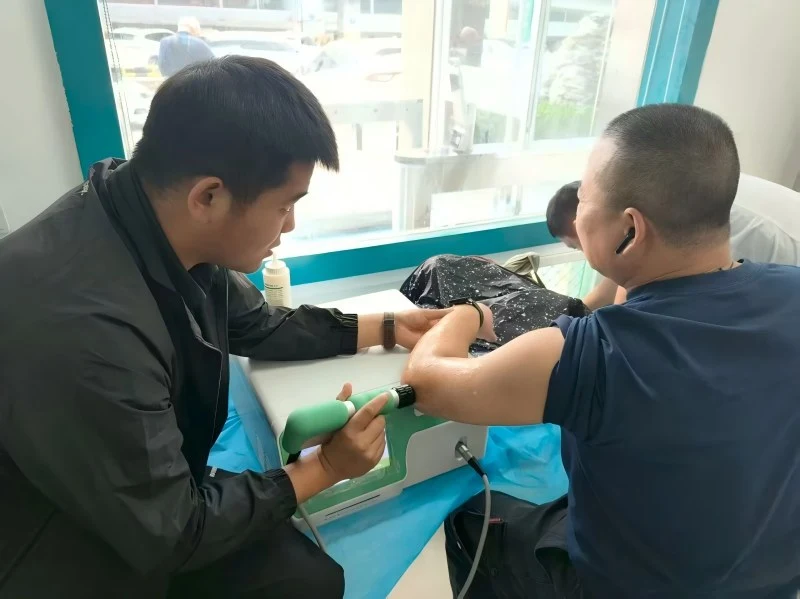
- Parameter Selection:
- Energy Flux Density (EFD): 0.10−0.25mJ/mm2
- Frequency: 4−6Hz
- Interval: 5–7 days (3–5 sessions per course)
- Localization: Utilizing dynamic palpation combined with ultrasound guidance to accurately target spastic muscle bundles and trigger points.
- Combined Therapy: Concurrent progressive stretching exercises (Smith et al., 2021) are recommended to enhance the efficacy of standalone ESWT.
Clinical Research Data
|
Research Indicators
|
Treatment Group (n=45)
|
Control Group (n=42)
|
|
ROM Improvement
|
68.7±12.3∘
|
42.5±9.8∘
|
|
Spasticity Relief Time
|
3.2±1.1weeks
|
5.8±2.3weeks
|
|
Functional Score
|
82.5±6.7
|
63.2±8.4
|
|
Data Source: Journal of Musculoskeletal Therapy, 2023
|
|
|
Technical Advantages
- High Repeatability: Allows for dynamic parameter adjustment based on patient response.
- Long-lasting Effects: Efficacy is maintained for 6–12 months in most patients (Zhou et al., 2023).
- Efficiency: A single treatment session is completed within 8–12 minutes.
Clinical Considerations
Pre-treatment Assessment:
- Local skin integrity
- Bone mineral density
- Recent medication history
Contraindications:
- Acute infection phase
- Coagulation disorders
- Implanted devices in the treatment area
Future Directions
- Intelligent Treatment Systems: Automatic parameter regulation integrated with EMG biofeedback.
- Molecular Mechanism Research: Exploring gene regulation of shockwaves on muscle fiber remodeling.
- Long-term Follow-up: Establishing tracking databases for efficacy exceeding 5 years.
References
(Refer to the original list provided in the text for Wang et al., Lee & Chen, Smith et al., and Zhou et al.)
Disclaimer: For medical professional reference only. This material is intended for internal academic exchange and does not constitute a diagnostic or medical basis. Please refer to product manuals for contraindications and precautions, and use under the guidance of qualified medical personnel.